← Back to catalog
Available now

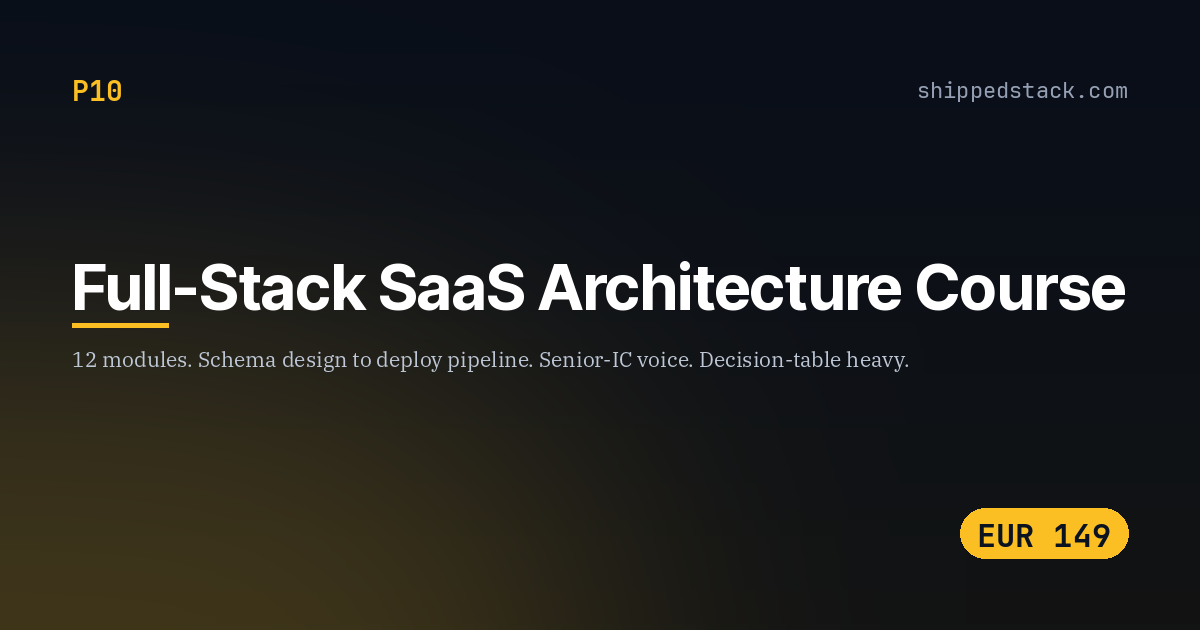
Full-Stack SaaS Architecture Course

12-module deep-dive on shipping full-stack SaaS, from schema design to deploy pipeline.

€149 one-time · single seat · 30-day refund

Premium tier — extended scope, 17,000+ words manuscript + 12 standalone course modules + 6 decision-table playbooks.

Full-Stack SaaS Architecture Course cover

Overview

The gap between "this works for now" and "this will work for five years" is where most SaaS fails. You've shipped a product to production. You felt the pressure: which database do you scale to? When do you extract services? How do you build for the deploy strategy that survives year three? This course is the field guide for that gap.

A 12-module deep-dive covering the architectural decisions that compound over years. Senior-IC voice. Written as decision tables that survive rereading at the moment of decision, not blog posts that feel obvious until you ship. The book assumes you've shipped to production at least once. It's not a tutorial — it's the perspective on architectural leverage you wish you'd had after your first three SaaS products.

Inside: ~17,000 words across a typeset book (PDF, EPUB, Markdown), twelve standalone course modules designed to be read individually as you face the corresponding decision, and six decision-table playbooks covering the architectural calls that come up most — database choice, auth storage, queue system design, caching strategy, deploy pipeline, and observability stack.

What's inside

M 01

Schema Design

Denormalization rules, indexing strategy, migration discipline. The two-clock rule, soft-delete trade-offs. The schema is the longest-lived artefact in your system — change it last.

M 02

Service Boundaries

When to extract, when to merge, the contract test pattern, the single-deploy-unit heuristic. Premature extraction is technical debt; late extraction is operational pain. The right timing frame.

M 03

API Design

REST patterns that survive, error shape consistency, versioning strategies, pagination, idempotency keys. The patterns that travel across team rewrites.

M 04

Auth & Sessions

Secure cookies in detail, multi-tenant isolation, OAuth2 flows for B2B, session storage trade-offs, CSRF defense. The security properties that don't degrade under pressure.

M 05

Queue Patterns

Async work patterns, retry semantics, dead-letter queues, idempotent consumers, the "exactly-once" myth. The discipline that separates slow systems from broken systems.

M 06

AI Integration

Provider abstraction, prompt versioning, RAG fundamentals, output validation, cost & latency budgets. Building with AI suppliers, not AI services.

M 07

Frontend Architecture

State management trade-offs, routing, hydration patterns, code-splitting strategy, the islands mental model. Shipping the right interface without the hydration debt.

M 08

Deploy Pipeline

Staging environments, canary releases, rollback strategy, immutable infrastructure, the deploy-is-reversible principle. Making deployment boring.

M 09

Observability

Structured logs, RED + USE metrics, error fingerprinting, sampling strategies. The visibility that prevents the 3 AM page.

M 10

Performance

Caching layers, the index-or-cache decision tree, CDN trade-offs, perceived performance. From slow to user-invisible.

M 11

Operational Rituals

On-call rotation design, the 3-step incident rule, blameless postmortems, runbooks vs tribal knowledge. The habits that make a product reliable.

M 12

The 5-Year View

What survives, when to rewrite, the 3-strikes rule for tech debt, paying down vs ignoring. Building for the long game.

DT 01

Database Choice — SQL vs NoSQL vs Hybrid

PostgreSQL as the default primary store. When to add specialist stores (Redis, BigQuery, Elasticsearch) on observable need, not by default. Trade-offs between operational burden and query expressiveness.

DT 02

Auth Storage — DB Session vs Redis vs JWT

Session storage options: database scaling, Redis invalidation, JWT statelessness. Trade-offs in revocation, scale, and security posture.

DT 03

Queue System — Redis vs Kafka vs SQS

Message queue options for async work. Redis for low-latency in-process, Kafka for high-throughput event streams, SQS for serverless. When to add a queue.

DT 04

Cache Tier — Application vs Redis vs CDN

Caching strategy: application cache for hot data, Redis for distributed state, CDN for static assets. The index-or-cache decision tree.

DT 05

Deploy Strategy — Canary vs Blue-Green vs Rolling

Deployment patterns: canary for gradual rollout, blue-green for instant switchover, rolling for slow drain. The deploy-is-reversible principle.

DT 06

Observability Stack — Self-Hosted vs SaaS vs Hybrid

Observability choices: self-hosted (cost + operational burden), SaaS (uptime dependency), hybrid (complexity). Metrics, logs, traces, and when to add each.
Who this is for

For you if

  • Senior developer shipping production SaaS solo or in small teams
  • Tech lead wanting to level up architectural decision-making
  • Shipped one product and want the second to start better
  • Need a decision framework, not a blog post — dense, concrete, actionable

Not for you if

  • Junior engineer learning what a database is — assumes production shipping experience
  • Looking for framework-specific recommendations — patterns are framework-independent
  • Want consultancy-deck generality — every claim is concrete enough to be wrong

Format & delivery

ZIP
Installable packOne ZIP with installer, book, course-modules/, decision-tables/. Drop into your docs folder or read standalone.
PDF
Book in 3 formatsPDF (typeset with TeX, hyperlinked), EPUB (for e-readers), Markdown (plain, greppable).
SH
Idempotent installerDrops course-modules/ and decision-tables/ into your project. --target / --dry-run / --force. Re-running is safe.
Single-seat licenseOne human user, any number of machines you personally control.
Lifetime v1.x updatesFree updates within the major version.
30-day refundNo questions asked, in-platform.
PDF

Free preview module

Module 1 — Schema Design — is available as a free preview PDF. ~1,000 words covering denormalization rules, indexing strategy, and migration discipline. Read it before deciding.

Download preview

How to work through it

Suggested 4–6 week pace. This is not a one-sitting read. The patterns are too dense; the decision tables won't stick if you skim them.

Week 1 — Foundations. Read modules 1–3 (Schema, Services, API). These are the highest-leverage chapters because they're hardest to change later. Re-read the decision tables at the end of each.

Week 2 — Core Plumbing. Read modules 4–6 (Auth, Queues, AI). These cover the cross-cutting concerns that touch every endpoint.

Week 3 — Edge & Delivery. Read modules 7–8 (Frontend, Deploy). These are the modules where patterns rotate fastest, but the underlying principles survive.

Week 4 — Operability. Read modules 9–10 (Observability, Performance). The discipline that turns a system from "ships features" to "ships features reliably".

Week 5 — Maintenance. Read modules 11–12 (Operational Rituals, 5-Year View). The longest-time-horizon material; re-read after a year in production.

Week 6 — Decision Tables. Print them. Pin them. Use them as the checklist before your next architectural commit.

Optional: Read one course module per week instead of sequential book reading. The course modules are written to stand alone; some readers prefer them as a slower, lower-density introduction.

FAQ

Is this text or video?

Text only. PDF (typeset), EPUB (for e-readers), and Markdown. No video. The course modules are standalone markdown files designed for re-reading at the moment of decision, not passive watching.

What stack do I need?

No specific stack required. The patterns translate to any modern SaaS — Node, Python, Ruby, Go, Java, Rust. Postgres, Redis, Stripe are used as common-knowledge reference points; the decisions transfer across.

What prerequisites do I need?

You've shipped at least one production system end-to-end. You're comfortable reading SQL, basic distributed-systems vocabulary (queue, cache, replica), and common HTTP patterns. You've been on-call at least once — the lessons land harder if you've felt the 3 AM page.

Do I get the decision tables as printable PDFs?

Yes. Each decision table is available as pure Markdown (renders perfectly on GitHub, GitLab, Notion, every static-site generator) and embedded in the main PDF. Print directly from PDF or convert markdown to PDF with your tool of choice.

Is there team licensing?

License is single-seat. Team license available on request — contact info@shippedstack.com with team size.

Can I modify the content for internal team use?

Yes. Single-seat license allows you to install into your own projects, internal codebases, and private repositories, and to modify the content for internal use. See LICENSE file for full terms.

When should I read this vs take a course on course platforms?

This is not a passive-watch product. It's a reference: something you read deeply once, then return to specific modules when you're facing the decision in your own system. If you prefer video walkthroughs, this is not the right product. If you want a decision framework you can grep and pin to your monitor, it is.

Will this become outdated?

The architectural patterns covered (schema design, service extraction, deploy strategy, observability) are stable across 5+ year cycles. When the patterns do shift (newer databases emerge, cloud-native changes scale assumptions), v1.x updates cover them — free for all buyers. Current version: 1.0.0.

Get the course

Full-Stack SaaS Architecture Course — €149 one-time, lifetime v1.x updates, 30-day refund. 12 modules, 6 decision tables, ~17,000 words.

Buy on Lemon Squeezy Buy on Gumroad